Gold ETF Flows: April 2026

The West returns to the fold

Published:

Highlights

  • Flows flipped positive in April, supported by inflows from all regions with Europe leading the charge.
  • These inflows lifted global gold ETFs’ AUM 1% higher to US$615bn; holdings rebounded by 45t to 4,137t.
  • Gold market liquidity stayed ample, despite m/m moderation, and above the 2025 average.

April in review

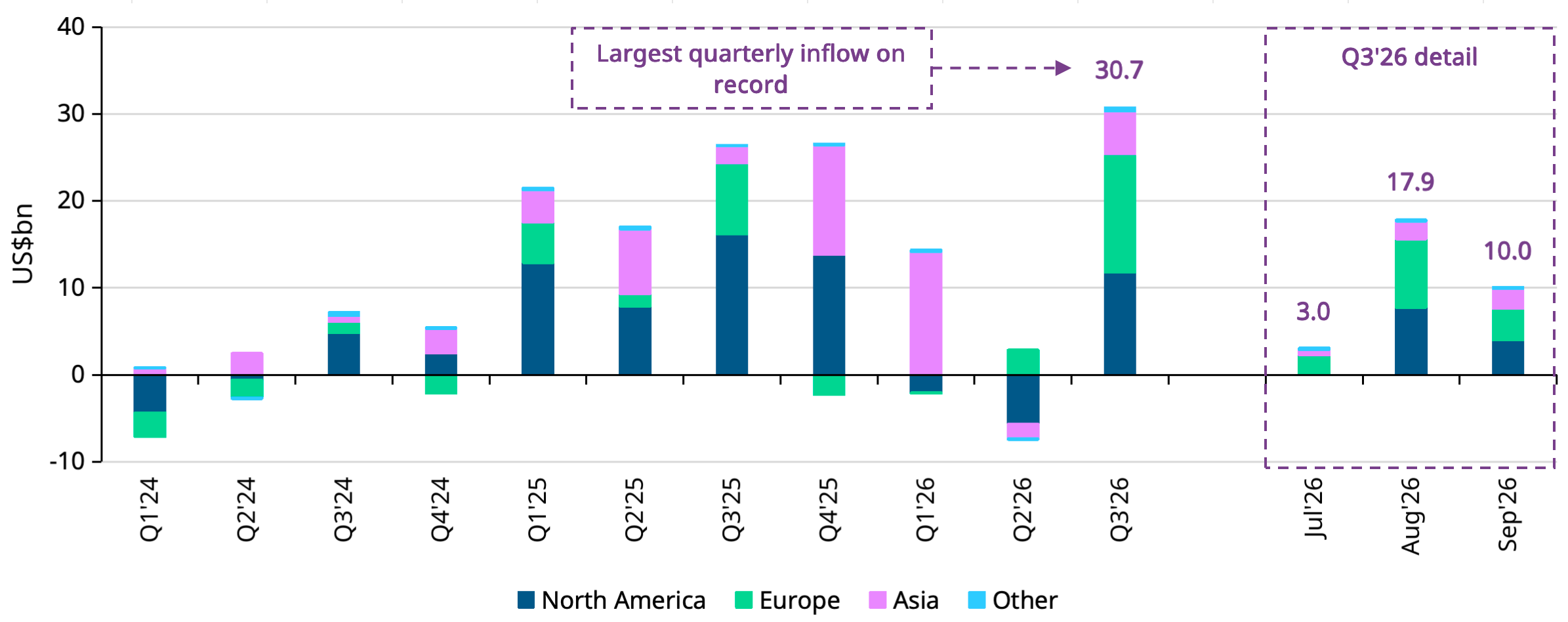
Global investors began rotating back into gold ETFs in April. Following notable outflows in March, global physically backed gold ETFs1 recorded inflows of US$6.6bn during the month. All regions registered positive flows with European funds leading others.

The April expansion lifted global gold ETFs’ total assets under management (AUM) to US$615bn, 1% higher m/m. Meanwhile, collective holdings also rose 1% to 4,137t, the third highest ever and just below the record high of 4,176t set on 27 February 2026 (Chart 1).

Chart 1: Global gold ETF flows flipped positive in April

Global gold ETF flows by region and average gold price*

*As of 30 April 2026. Gold price based on the quarterly and monthly average LBMA Gold Price PM in USD.
Source: Bloomberg, Company Filings, ICE Benchmark Administration, World Gold Council

Regional overview

North America reversed course in April, recording inflows of US$1bn. The rebound was concentrated in the first half of the month, as gold recovered from its March lows and broader market pressures eased. 

Flows softened again in the back half of April as the US-Iran conflict showed signs of further escalation and higher opportunity costs re-emerged through a stronger dollar and higher yields.

As shown in Chart 2, North American gold ETF outflows intensified as market-based pressure rose in early March, consistent with a broader macro-pressure and liquidity event rather than a simple oil-only rotation. The subsequent easing in pressure helped flows stabilise in early April, although the recovery remained choppy into month-end. 

Chart 2: North American gold ETF outflows intensified as market pressure rose again

North America gold ETF fund flows and market pressure*

*Data as of 30 April 2026. Market pressure score is an equal-weighted average of z-scored yield pressure, S&P 500 weakness, 1-year breakeven changes, WTI returns, DXY returns, and changes in the SOFR-EFFR funding spread. Higher values indicate more pressure on gold ETF demand.
Source: Bloomberg, World Gold Council


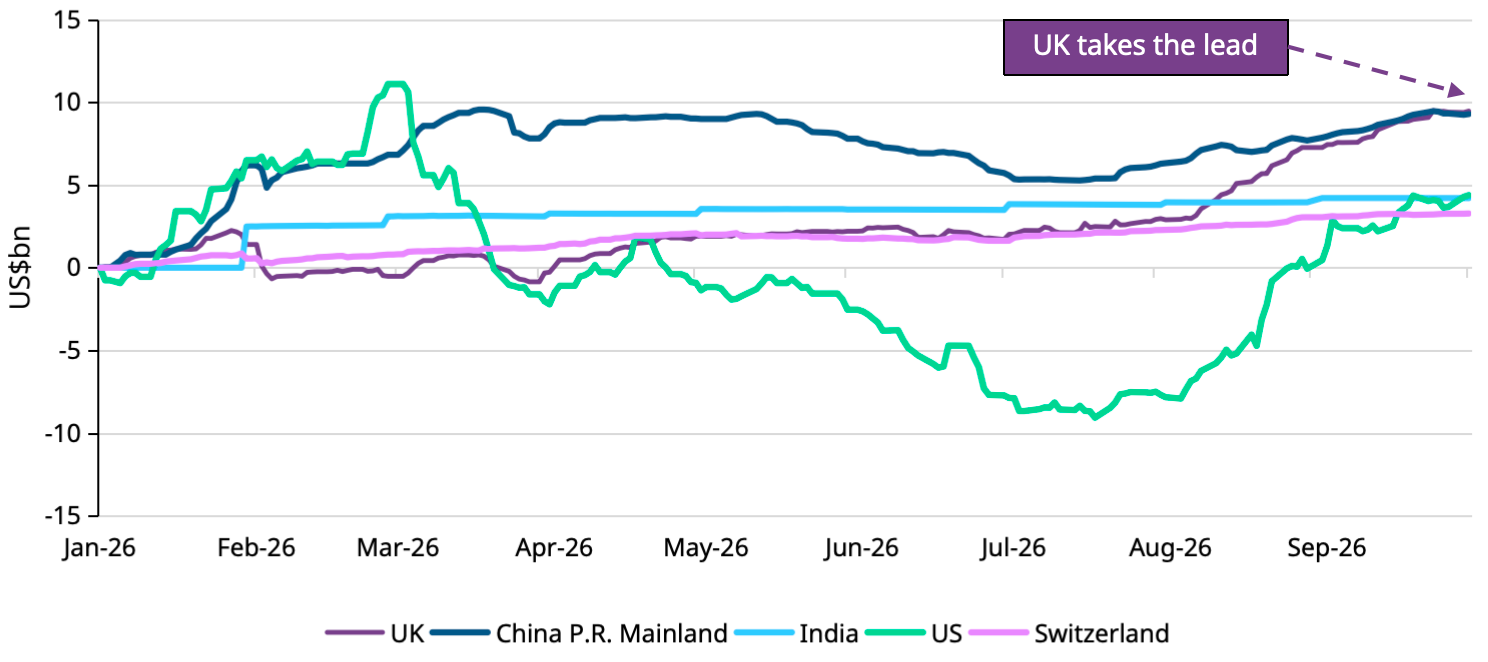
European funds saw a large inflow of US$3.7bn in April, flipping their y-t-d total from negative to positive, at US$3.7bn. The UK led the surge, while Switzerland and Germany also contributed meaningfully. Positive flows in the region appeared linked to heightened geopolitical and geoeconomic risks, as investors assessed the inflationary implications of a more protracted Iran conflict and the associated pressure on energy prices. And with local equities retreating and the BoE less hawkish than expected, investor interest in gold likely strengthened as prices recovered and stabilised.

Gold ETFs in Asia extended their inflow streak to eight months, adding US$1.8bn in April. The region remains important to watch, with y-t-d flows currently on pace to challenge last year’s record total. China led the region: funds in Hong Kong SAR added US$732mn, a record month, supported by new product’s listing;2 and gold ETFs in Mainland China continued to draw inflows (+US$498mn) amid elevated geopolitical tensions, falling yields, and continued official-sector gold buying announcement. India recorded positive flows of US$297mn in April, its 11th consecutive month of inflows, and Japan attracted US$246mn.3

Funds in other regions recorded solid inflows of US$106mn. Unlike the choppier flow patterns seen across major regions, these markets saw steady, marginal buying throughout April, led by Australia and South Africa. 


Gold ETF flows

Data as of

Demand captures changes in global/regional gold holdings; fund flows capture the net amount of money (in USD) that comes in or out of gold ETFs globally/regionally. See methodology note.

Trading activity normalises

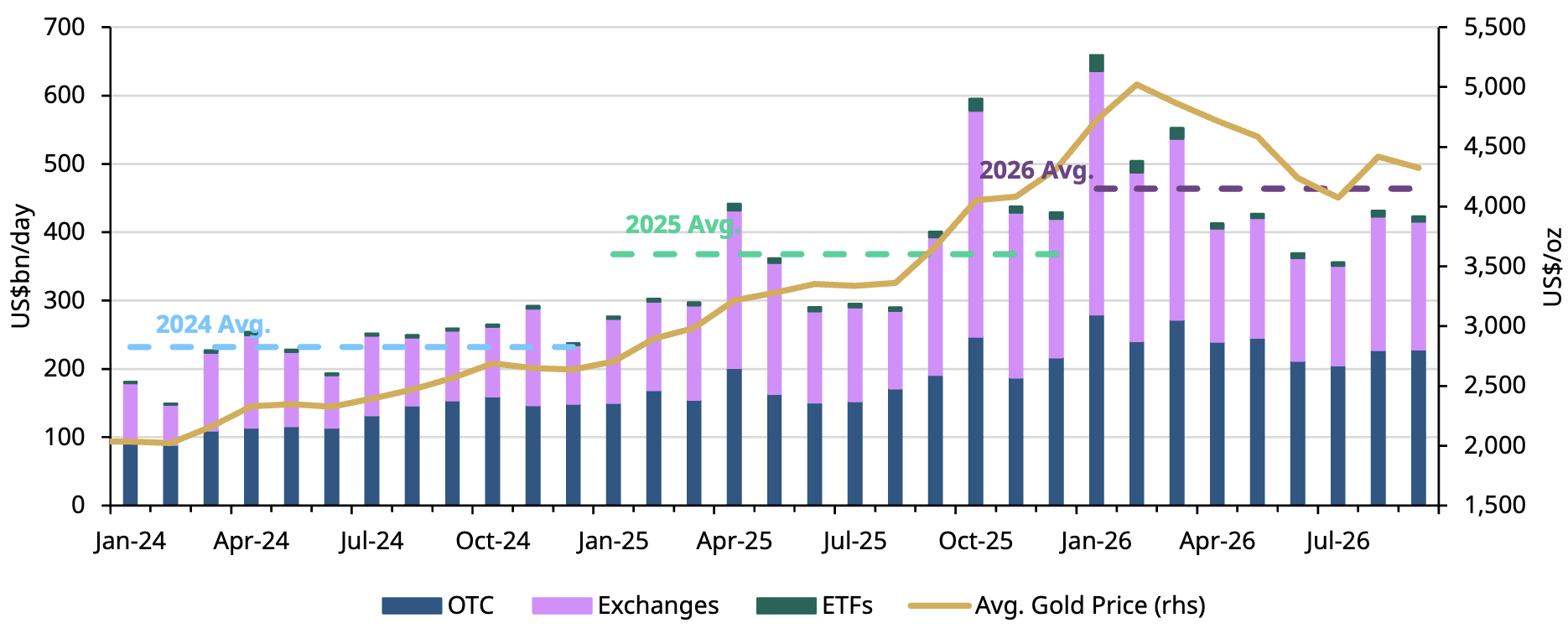
Global gold market trading volumes4 fell 24% m/m to US$398bn/day in April. Despite the m/m decline, volumes in April remained above the 2025 average of US$361bn/day, signalling ample gold market liquidity. All segments experienced slower trading activities in the month, albeit to different extents. Over-the-counter volumes declined by 10% in the month to US$244bn/day, which stayed well above the 2025 average of US$180bn/day. Trading activities at exchanges also cooled, dropping 38% m/m to US$147bn/day – both COMEX and the Shanghai Futures Exchange experienced lower volumes. Global gold ETF trading volumes also fell yet remaining around their 2025 average of US$7bn. 

Positioning data pointed to a modest easing in total COMEX net longs, which declined 4% over the month to 477t.5 While managed money positions briefly rebuilt after March’s sell‑off, early‑month additions of 15t were more than offset by late‑month selling of around 23t. Non‑reportable positions, often associated with retail activity, followed a similar pattern, with modest early additions giving way to a drawdown of roughly 14t, leaving net positions down 8.6t in April.

Chart 3: Trading volumes eased alongside a rangebound gold price

Average daily trading volumes by segment*
*Data as of 30 April 2026. Gold price based on the monthly average LBMA PM Gold Price USD. 
For more information on trading volumes please visit our Trading Volumes page on Goldhub: Gold Trading Volume | Gold Daily Volume | World Gold Council.
Source: Bloomberg, Nasdaq, COMEX, ICE Benchmark Administration, Shanghai Gold Exchange, Shanghai Futures Exchange, ETF providers, Multi Commodity Exchange of India, Dubai Gold & Commodities Exchange, Japan Exchange Group, Thailand Futures Exchange, Borsa Istanbul, Bursa Malaysia, Korea Exchange, World Gold Council

Footnotes

  1. We define gold ETFs as regulated securities that hold gold in physical form. These include open-ended funds traded on regulated exchanges and other regulated products such as closed-end funds and mutual funds. A complete list is included in the gold ETF section of Goldhub.com.

  2. While our estimates show that India has seen inflows 11 months in a row, official data from the Association of Mutual Funds of India indicates this is the 12th consecutive monthly inflow due to minor methodology differences. For more, see: ETF Flows Data Methodology

  3. Due to LBMA trading volume data availability, our full trading volume dataset dates back to 2019.

  4. Based on CFTC positioning report as of 28 April 2026. 

Disclaimer [+]Disclaimer [-]